

Mind the (Fear) Gap
Why the growing distance between ambition and anxiety is the real perfectionism story.


It’s the early 1990s, and a strange coincidence has just rocked the perfectionism community. In the short space of a year, two perfectionism scales were published. That might not sound remarkable at first glance, but consider this: they shared the same name, they were built to answer the same basic question, and neither group of researchers knew the other was developing them.
What these two instruments captured, independently and from entirely different angles, would turn out to be the most complete portrait of perfectionism that psychological science has ever produced. And when, three decades later, we finally brought them together in a single analysis, a generational shift emerged that was so large it dwarfed everything else in the dataset.
But I’m getting ahead of myself. To really understand that analysis, we have to know how we got here.
Back in the late 1980s, burrowed away in a psychology department at York University in Toronto, Paul Hewitt and Gordon Flett were developing a new measure of perfectionism. They’d spent years refining a set of items that captured where perfectionism comes from, or to be more exact, whether it’s directed at yourself, imposed on others, or perceived as demanded by the world around you. Their instrument, the Multidimensional Perfectionism Scale, would be published in the Journal of Personality and Social Psychology in 1991 and go on to become the most widely used perfectionism measure in the world.
At exactly the same time, over a thousand kilometres south, at Smith College in Northampton, Massachusetts, a psychologist named Randy Frost was doing something similar. He, too, was building a multidimensional perfectionism scale. He, too, called it the Multidimensional Perfectionism Scale. And he, too, was animated by the same idea that perfectionism is not one thing but many, and that if you want to understand why it causes so much damage, you first need to take it apart.
Two groups of researchers, two instruments with the exact same name, and both published within a year of each other, neither aware of the other’s work until it appeared in print.
What makes this coincidence more than a curiosity is what each group chose to measure. Paul and Gord asked where perfectionism comes from. Is it self-generated? Is it perceived? Is it directed outward at the people around you? Their scale maps the relational makeup of perfectionism.
Who’s demanding perfection and from whom?
Randy Frost asked a slightly different question, one that would turn out to be just as consequential: what does perfectionism feel like?
While Paul and Gord’s scale captures the relational elements of perfectionism, Frost’s taps into its lived experience — the racing thoughts before submitting an assignment, the compulsive re-checking of an email before hitting send, the sinking feeling after even tiny errors that most people would shrug off. He measured concerns about mistakes, doubts about actions, and personal standards. These are the reverberations of perfectionism, the way it actually feels to live inside it, hour by hour, day by day.
For three decades, these two traditions have run in parallel, each spurring its own vast body of research, its own citation networks, its own scholarly communities. And in 1993, Frost himself showed that the two scales, despite their very different starting points, converge on the same underlying structure.
We’ll come to that structure in a later blog. But first, there’s a gap in the evidence that our new research fills for the very first time.
When Andrew Hill and I published our 2019 paper showing that perfectionism was rising among college students, we used only Paul and Gord’s scale. We tracked self-oriented and socially prescribed perfectionism across generations and found significant increases in both, with socially prescribed perfectionism surging in a way that made headlines worldwide.
But we couldn’t say anything about what Frost’s scale was doing, and that nagged at us.
We couldn’t say whether the experience of perfectionism — the fear, the doubt, the self-criticism — was changing alongside its source. Paul and Gord’s model tells you that young people increasingly believe the world demands perfection from them, which is alarming enough, but it doesn’t tell you how that demand feels from the inside. It doesn’t tell you what happens in the long hours between the expectation and the response, when a person is alone with their thoughts about whether they’re equal to what’s being asked of them.
Frost’s model does.
And that’s why, in our new paper just published in Psychological Bulletin, we added his dimensions to our analysis. We gathered every available dataset reporting college students' scores on personal standards, concerns over mistakes, and doubts about actions, spanning the same 35-year window and the same three countries as before (UK, US, and Canada). And when we plotted the data in chronological order, one trend leapt off the screen.
Concern over mistakes
Concern over mistakes has risen by almost a full standard deviation over thirty-five years, which is an almost sixty per cent increase. By any convention in the social sciences, that's a large effect. And it is, by a considerable margin, the most seismic generational shift of any perfectionism dimension in our entire study, at nearly four times the increase in personal standards and comfortably exceeding the increases in self-oriented perfectionism, socially prescribed perfectionism, and doubts about actions. Nothing else comes close.
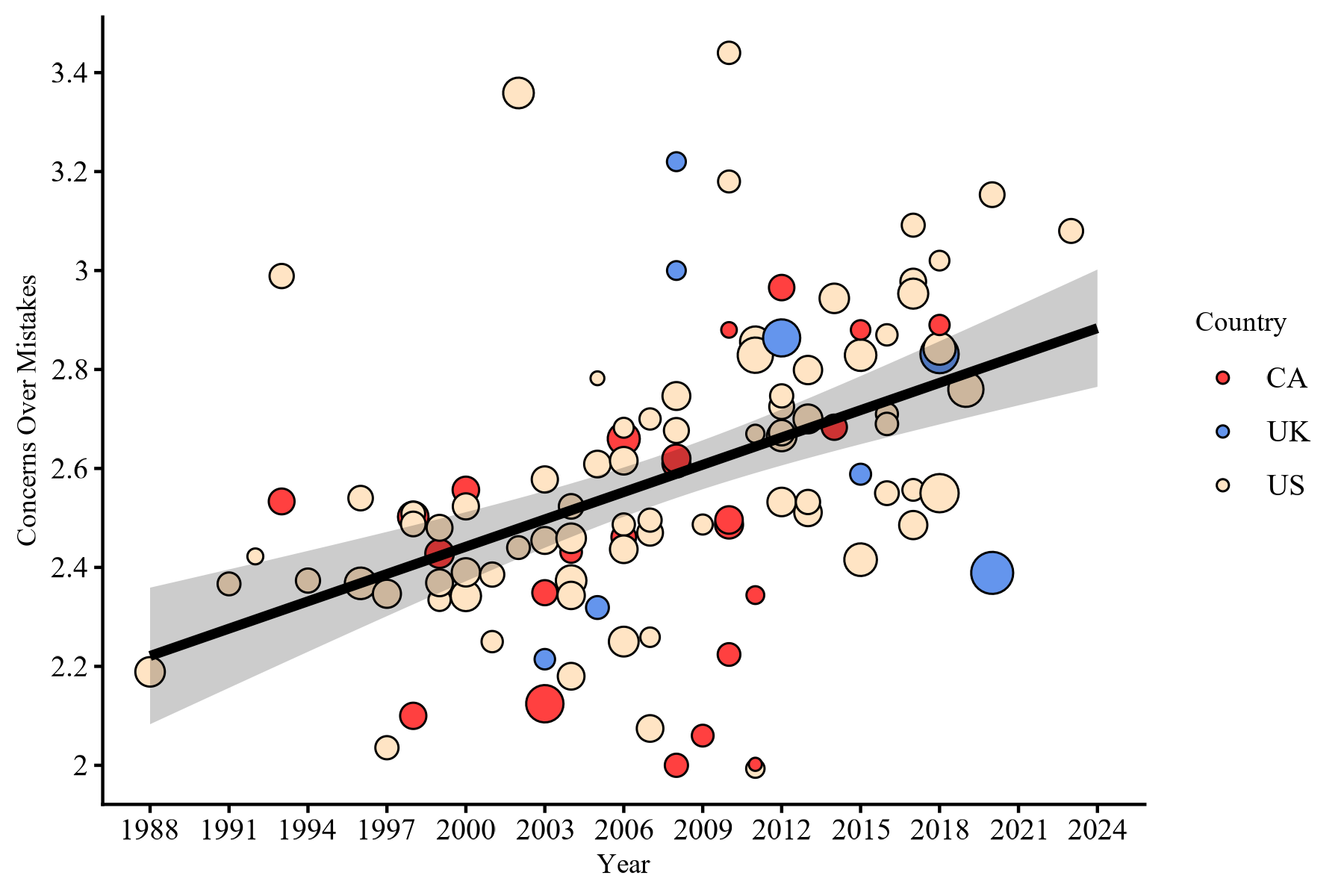
What do concerns over mistakes actually capture? According to a detailed analysis by Martin Smith and colleagues, the dimension has three core elements that, taken together, describe a particular kind of psychological paralysis.
The first is a tendency to react negatively to mistakes with heightened and prolonged distress. The second is a tendency to equate mistakes with personal failure and treat errors as evidence that you’re irredeemably flawed. The third is a belief that others will judge you harshly for those mistakes, that your errors are not private mishaps but public exposures.
Smith and colleagues argue that the dimension should really be called “concerns over mistakes and failure sensitivity.” I’m inclined to agree.
People high on this dimension do not simply dislike making mistakes or treat them as an occupational hazard. They’re terrified of them in a way that takes over their daily experience. They anticipate mistakes before they happen, constructing elaborate mental scenarios of failure. They ruminate about them obsessively after the fact, replaying errors on a loop long after anyone else has forgotten. They avoid situations where mistakes are possible, particularly public or evaluative ones. And they go to great lengths to conceal their mistakes from others, presenting a carefully curated exterior while the interior spins out with anxiety.
These tendencies — anticipatory dread, retrospective rumination, impression management — have increased by nearly a full standard deviation in a single generation. That means a young person scoring at the average in 2024 would have been well above the midpoint of the distribution in 1989. What was once an uncomfortably high level of mistake sensitivity has become, for today’s college students, something closer to the norm.
Doubts About Actions
Alongside concerns over mistakes, doubts about actions also increased significantly over the 35-year timeframe. This dimension captures something slightly different from the fear of mistakes, something a little more habitual and diffuse: the gnawing sense that you haven’t quite done things correctly, the inability to feel that a task is truly finished, a persistent low-grade hum of uncertainty about your own competence that never fully resolves itself, even when the work is done and the feedback is glowing.
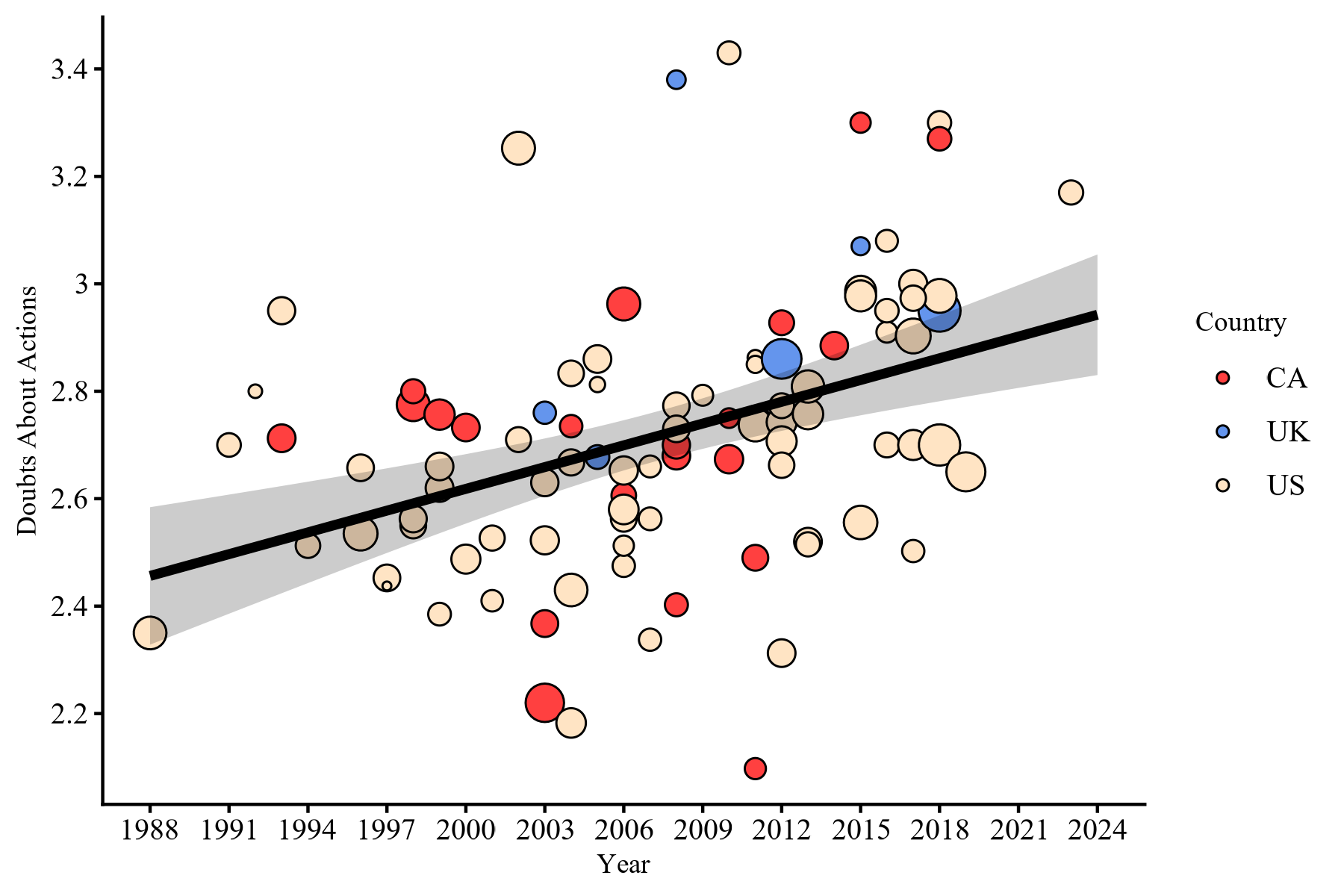
People high in doubts about actions tend to procrastinate, born from an inability to decide whether their work meets the required standard. They check and re-check. They struggle to commit to decisions because every option feels like the wrong one. They start things and can’t stop tinkering with them, trapped in a cycle of revision that has less to do with improving quality than with managing the anxiety that something might not be right. If you can never be sure you’ve done something correctly, the only available strategies are to keep checking or to avoid starting in the first place.
The increase is meaningful, and it paints a troubling portrait of generational change. Recent cohorts of college students appear to doubt themselves more and find it increasingly difficult to focus, make decisions, and complete tasks, compared with those who came before them.
Personal Standards
Now compare these findings with personal standards, the Frost dimension that captures the tendency to set high goals and evaluate yourself against them. Personal standards also increased over time, but modestly. The increase is real and statistically significant, and it tells us that young people today set somewhat higher standards for themselves than previous generations did.
But, tellingly, the anxiety about meeting those standards has risen far more dramatically, and that asymmetry is, I think, one of the most important findings in our entire study.
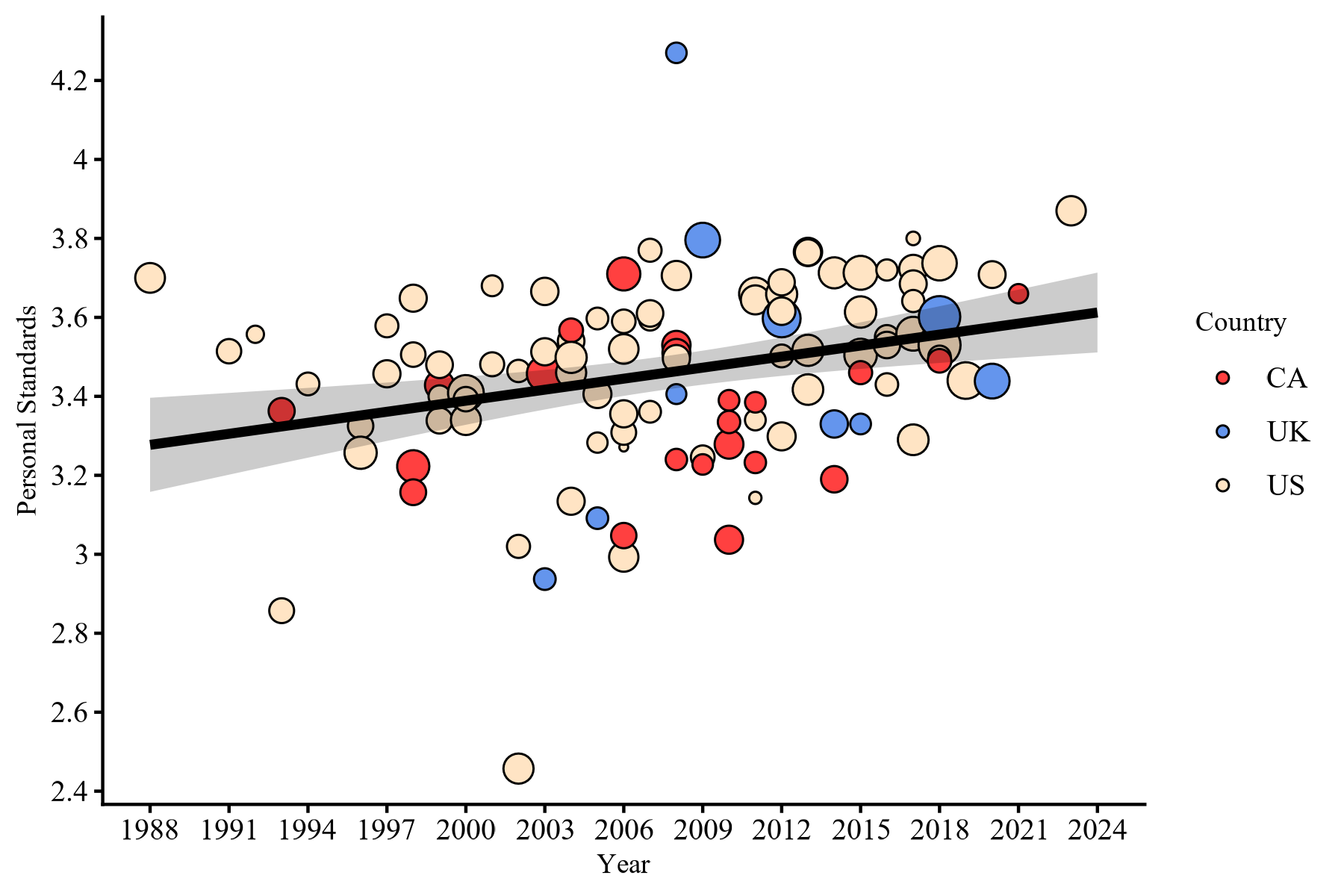
Imagine two students, one from 1988 and one from 2024, both sitting down to write an essay. The 2024 student sets a somewhat higher bar for what constitutes good work since she always wants the argument to be tighter, the prose sharper, the research more thorough. Fine. But the 2024 student is also massively more worried about making mistakes, far more likely to interpret a poor grade as evidence of personal inadequacy, and considerably more uncertain about whether the essay is good enough to submit at all. She might stare at the final paragraph for an hour, unable to decide whether to press send, paralysed by a level of fear that the 1988 student would’ve found bewildering.
The ambition has grown a little. The fear has grown a lot. I call this the fear gap.
Perfectionism is often discussed as though it were primarily about standards, about wanting to be excellent, about reaching for the highest possible shelf. The trends for Frost’s dimensions reveal something more unsettling. The real generational shift is not in the standards themselves but in the emotional and cognitive distress that now accompanies them. The self-doubt, the mistake sensitivity, the paralysing uncertainty, the deep-seated conviction that whatever you’ve done, it probably isn’t enough.
That’s the fear gap. The gaping gulf between what young people demand of themselves, on the one hand, and the terror they feel about putting it all into action, on the other. And with each passing year, that gap is widening.
Which is a lot to digest at once. So let’s take a step back and consider what these two perfectionism traditions — Hewitt and Flett’s and Frost’s — are telling us when you read them side by side.
Paul and Gord’s scale shows that young people increasingly believe the world demands perfection from them. Socially prescribed perfectionism is accelerating, bending into a curve that shows no sign of levelling off.
Frost’s scale shows what that mounting pressure is doing to their interiors. They’re becoming more terrified of mistakes, more consumed by self-doubt, more uncertain about whether they’ve done things well enough, and more inclined to hide their imperfections behind carefully maintained facades. The internal cost is rising in parallel with the external demand, and in the case of concerns over mistakes, it’s rising faster than anything else in the dataset.
The fact that both traditions, developed independently by researchers who didn't know each other's work existed, converge on the same conclusion is perhaps the strongest evidence we have that something real, meaningful, and consequential is changing in the psychology of young people.
Randy Frost, working from his office in Massachusetts, and Paul Hewitt and Gordon Flett, working from theirs in Toronto and Vancouver, could not have possibly known in the early 1990s that their multidimensional perfectionism scales would one day be woven together in a single analysis spanning more than 35 years. But the complementarity they stumbled into turns out to be a way of seeing perfectionism in the round, from the outside and the inside, all at once.
One tradition asks, where does perfectionism come from? The other asks what does it do to you once it arrives?
The answer to the first question: from every direction, and with increasing intensity.
The answer to the second: it hurts, and it hurts more with every passing year.
Our research paper can be downloaded for free here: https://www.apa.org/pubs/journals/releases/bul-bul0000518.pdf